Neighbouring group participation or NGP in organic chemistry has been defined by IUPAC as the interaction of a reaction centre with a lone pair of electrons in an atom or the electrons present in a sigma bond or pi bond . When NGP is in operation it is normal for the reaction rate to be increased. It is also possible for the stereochemistry of the reaction to be abnormal (or unexpected) when compared with a normal reaction. While it is possible for neighbouring groups to influence many reactions in organic chemistry (For instance the reaction of a diene such as cyclohex-1,3-diene with maleic anhydride normally gives the endo isomer because of a secondary effect {overlap of the carbonyl group π orbitals with the transition state in the Diels-Alder reaction}) this page is limited to neighbouring group effects seen with carbocations and SN2 reactions.
NGP by heteroatom lone pairs
A classic example of NGP is the reaction of a sulfur or nitrogen mustard with a nucleophile, the rate of reaction is much higher for the sulfur mustard and a nucleophile than it would be for a primary alkyl chloride without a heteroatom.
A classic example of NGP is the reaction of a sulfur or nitrogen mustard with a nucleophile, the rate of reaction is much higher for the sulfur mustard and a nucleophile than it would be for a primary alkyl chloride without a heteroatom.

In sugar chemistry anchimeric assistance is an example of NGP.
NGP by an alkene
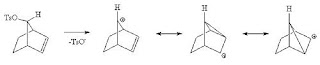
The π orbitals of an alkene can stabilize a transition state by helping to delocalize the positive charge of the carbocation. For instance the unsaturated tosylate will react more quickly with a nucleophile than the saturated tosylate.
The π orbitals of an alkene can stabilize a transition state by helping to delocalize the positive charge of the carbocation. For instance the unsaturated tosylate will react more quickly with a nucleophile than the saturated tosylate.

The carbocationic intermediate will be stabilized by resonance where the positive charge is spread over several atoms, in the diagram below this is shown.